Before the Book Club
Spittoon’s Event Coordinator Sara F. Costa has been in contact with Lijia Zhang in anticipation of her Spittoon Book Club talk on the 19th of January. Lijia was kind enough to provide us with a compelling interview which serves as a taster for the event.
Lotus by Lijia Zhang will be the first Book Club book of 2019. On Saturday January 19th at 8PM, Spittoon Book Club will host a session with the author herself at Camera Stylo.
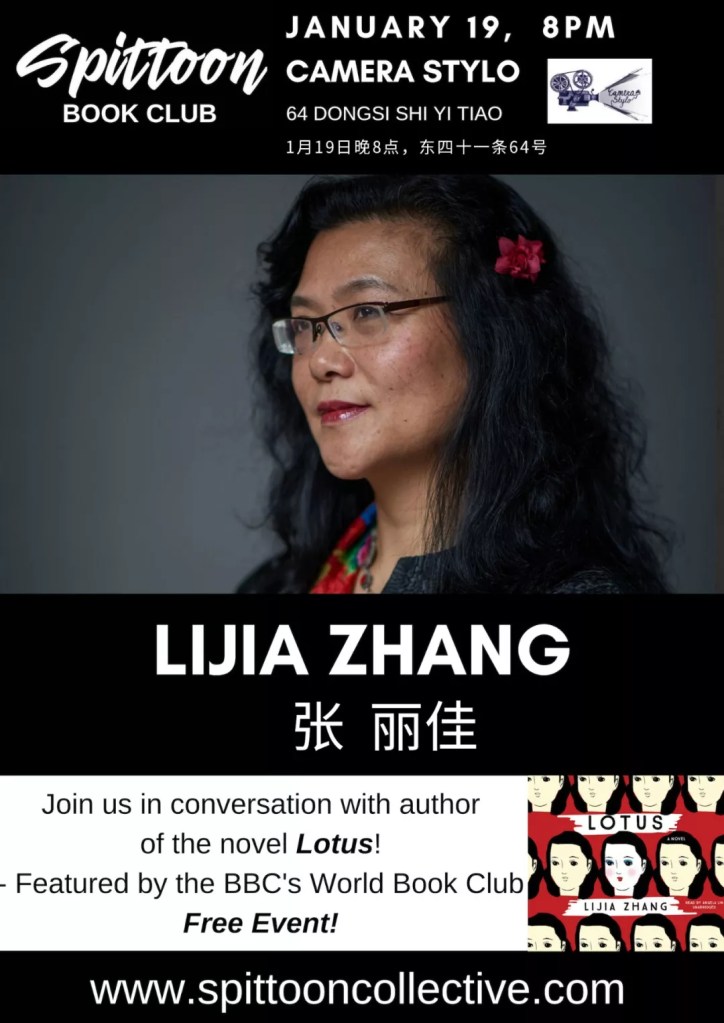
In the initial phases of the Reform and Opening up era, when Lijia was 16 years old, she had to drop out of school and work in a rocket factory for ten years. Still pursuing her childhood dream of becoming a writer, she taught herself English at the same time. Today, she writes regularly in English for international publications like The Guardian, The South China Morning Post, Newsweek and The New York Times. She is the author of the critically acclaimed memoir Socialism Is Great!, about her rocket factory experience, and her debut novel Lotus, focusing on prostitution in contemporary China, was published by Macmillan in January 2017.
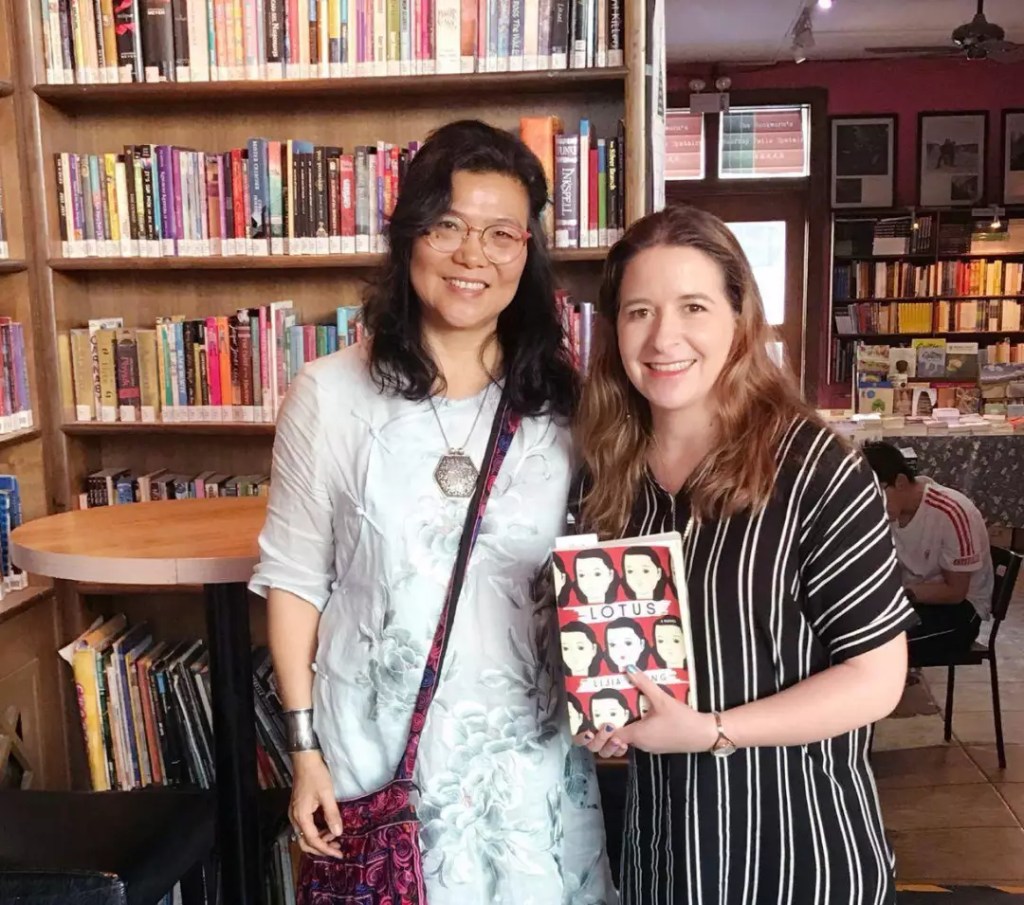
at The Bookworm Cafe in Beijing
SFC: I find it fascinating that Lotus was inspired by the real-life story of your grandmother, although I’m aware that you also did a lot of research on the lives of sex workers in China, particularly in Shenzhen. Why are you so fascinated by the subject?
LZ: Not long after I discovered my grandma’s secret, I bumped into a hair salon (brothel).
LZ: The book took me 12 years to complete. I did conduct some interviews before starting to write the book. But in my earlier drafts, the characters simply didn’t jump off the page. To deepen my understanding of the girls, I worked, on and off for months, for a NGO in a northern city. I made friends with several sex workers who kindly opened up to me and shared their life stories with me.
SFC: Do you see Shenzhen as “the city of sins” in China?
LZ: Yes, it has the reputation as China’s “Capital of Sins”. Prostitution exists in just about every Chinese city where there’s always an unmarked “red light district”. But the underground sex industry has particularly flourished in rich coastal cities such as Shenzhen.
SFC: How do you react to some critiques that say that the novel is voyeuristic or exploitative in regards to sex scenes?
LZ: I think, in some sense, all writers are voyeuristic. Exploitative? I don’t think I am guilty of that. I believe I portrayed the working girls with understanding and empathy. My aim is to give them a voice and indeed their humanity.
SFC: Your approach to the theme of prostitution in the novel is both a sociological approach as well as a very intimate and psychological one, denouncing the stigma associated with it but also explaining the inner feelings of the main character. Which approach motivated you more to write this book?
LZ: I come from a journalistic background. So I wanted to explore social tensions brought by the reforms and opening up through the lens of prostitution. But a decent novel should be a good psychological study of the main characters. So both approaches.
SFC: Prostitution seems to be a central theme in this novel in a first look, but there’s also a very clear criticism of working conditions in factories. Do you think personal traumas can be a consequence of social structures?
LZ: It is indeed a novel of social criticism. I wanted to expose social tension and injustice caused by the recent transformation, for example, of the growing rural urban divide and the growing gender inequality and so on. Women have shouldered too much of the burden and cost as China has shifted from the planned economy to market economy. It drove some of the most vulnerable ones to take up the flesh trade.
SFC: It seems that in your book, prostitution is portrayed as a legitimate choice when rampant capitalism condemns a young woman to a life without any thrill or space for individual expression.
LZ: I certainly wouldn’t use the word ‘legitimate’. Rather, for some most vulnerable women, it is one of the few or only choice they have, to sell their own bodies. For girls serving the upscale market, it is sometimes a lifestyle choice, a way to obtain quick money. For clients, yes, some visit prostitutes for seeking thrill, among other reasons.
SFC: At some point in the book, Lotus finds pleasure with one of her clients, one pleasure that she never felt before. Stigma on prostitution is one thing, but the stigma of women’s sexuality is also another subject that you touch upon.
LZ: I’d like to portray women as three dimensional human beings with sexual desires. I found it quite interesting that some women experienced sexual pleasure that they never experienced with their husbands. Some felt bad about it as they regarded their work as ‘dirty’ and it felt wrong to get pleasure out of this disgraceful job. This is one of the reasons that Lotus turns to Buddha, to cleanse herself.
SFC: Lotus finds a very understanding and open-minded man in the character of the photographer Bing but their relationship is still complicated. What was the meaning behind Bing’s character?
LZ: The photographer Bing is obsessed in photographing the girls. Apart from the noble reasons, there are also selfish reasons. It is a complicated relationship because they come from such different backgrounds and have different expectations. By introducing the character Bing, a better educated urban man, I was able to discuss some broad social issues.
SFC: In the end, we learn that Lotus’ happiness is not going to be dependent on her relationship with a man.
LZ: Yes, for me, it is a novel about a young woman finding herself.
SFC: We need more novels about sex, money and guanxi.
LZ: Of course!
Originally published 7 January 2019 on the Spittoon WeChat channel. Archive reference #37.


Leave a comment