Part of the Spittoon Arts Collective archive. Gothenburg chapter launched 2017.
Taking Spittoon to Sweden
In 2017, Chilean-born filmmaker and poet Matias Ruiz-Tagle — formerly of Spittoon Beijing — left China and relocated to Gothenburg, Sweden. He didn’t start again from scratch. He took Spittoon with him.
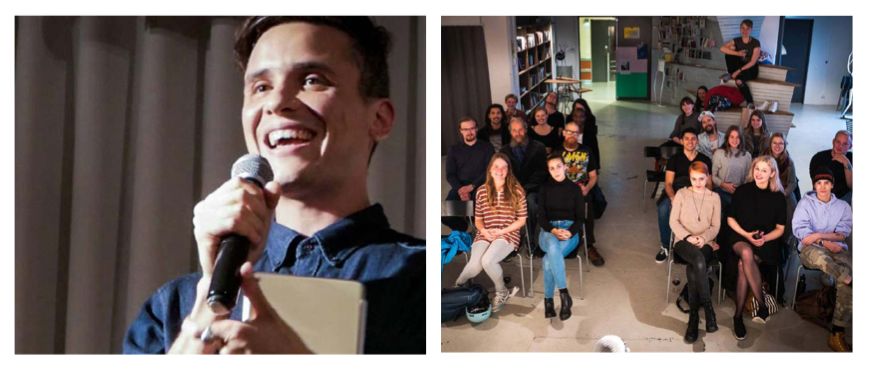
Spittoon Gothenburg established monthly reading nights at Göteborgs Litteraturhus on the last Thursday of each month, built a core organising team, and developed a distinctive style: experimental, surreal, performance-driven, often bilingual in Swedish and English. The Beijing model had crossed a continent and taken root.
Key Achievements
Göteborgs Litteraturhus
Monthly reading nights at one of Sweden’s most respected literary venues. A permanent home that gave Spittoon Gothenburg institutional credibility from early in its existence.
Nobel Week — Stockholm
Spittoon Gothenburg was commissioned to produce a video and poetry collaboration for Nobel Week in Stockholm — paid by the Nobel Foundation. The project involved working with South African spoken word group Hear My Voice, combining film, text, and performance in the tradition Matias had developed: roughly sixty percent text, forty percent multimedia.
Gothenburg Book Fair
A commission at the Gothenburg Book Fair — one of the largest literary events in Scandinavia. Spittoon Gothenburg performed and presented at an event that draws publishers, writers, and readers from across Europe.
Spittoon Connect: The Shimmering Wall — April 2019
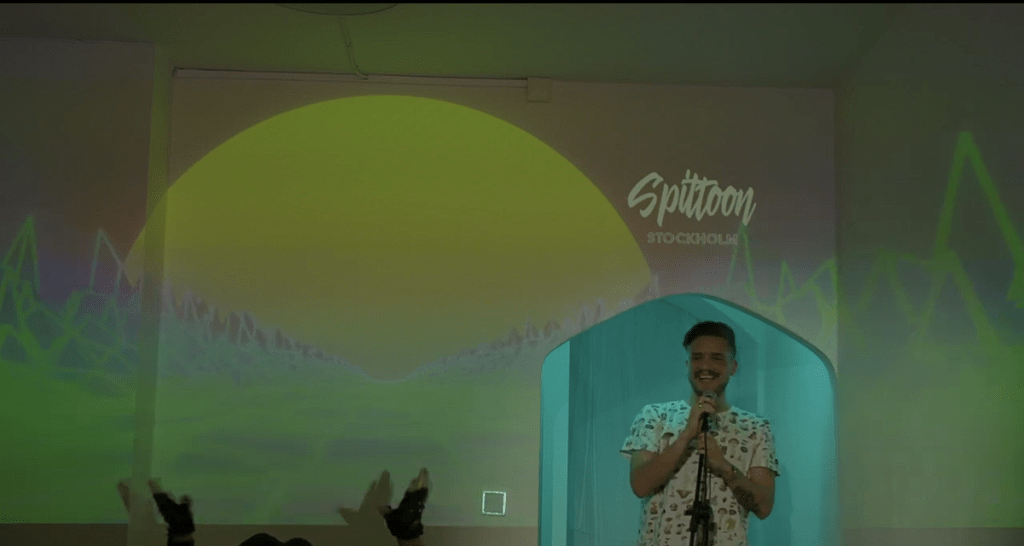
On April 28, 2019, Spittoon staged a simultaneous livestream event connecting Beijing and Gothenburg in real time. Poets and musicians performed to both audiences via large projector screens — two cities, two continents, one event. The Shimmering Wall was one of the most technically and artistically ambitious things Spittoon had attempted, and it worked.
Beijing and Gothenburg connected live · Poets and musicians performing simultaneously across two continents
A Different Kind of Spittoon
Matias described his artistic approach as sixty percent text, forty percent multimedia — video, music, projections, mapping, lights. Spittoon Gothenburg extended the model into visual and digital territory that the Beijing chapter had pointed toward but never fully explored. Motion poem videos, immersive installations, and cross-continental collaborations became its signature.
What started as one person carrying an idea from Beijing to Sweden became something genuinely distinct — proof that the Spittoon model was not dependent on any single city, founder, or format.
Read the Gothenburg Archive
Articles and event write-ups from Spittoon Gothenburg — republished from the original WeChat archive.
 matthew-byrne.com